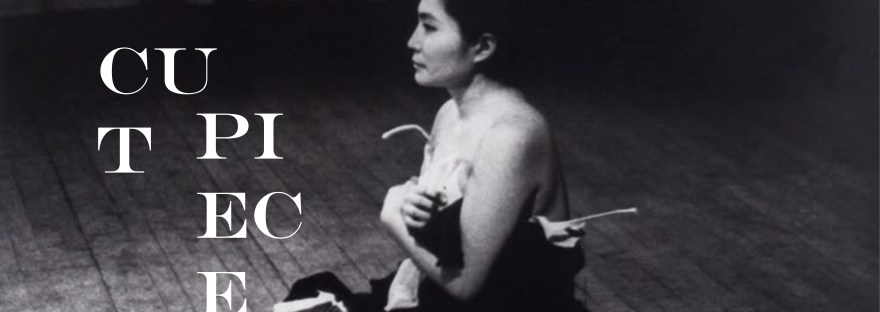
Cut Piece is a performance art and participatory work created by Japanese artist and musician Yoko Ono. It was performed for the first time by herself on July 20, 1964, at the Yamaichi Concert Hall in Kyoto, Japan. It is known as one of earliest and most significant works of the feminist art movement and Fluxus.

Cut Piece is a rich and poetic work of art that allows very different readings. That’s because it raises questions about the nature of the artist-artwork-audience relationship, making the audience into collaborators, and in so doing, it deliberately offers its performers, audiences, and critics an opportunity to project their own “meaning” into the work.
First performances
It was performed by Ono at least in 6 occasions, and by other artists many times more. The first two performances took place in Japan, in Kyoto and Tokyo in July and August 1964. The third performance was presented in United States at Carnegie Recital Hall in New York City in March 1965. The next two performances took place in London in September 1966 as part of the Destruction in Art Symposium presentation of Two Evenings with Yoko Ono. She directed later performances of Cut Piece, and till September 2003, these were the only confirmed occasions on which she herself publicly performed.

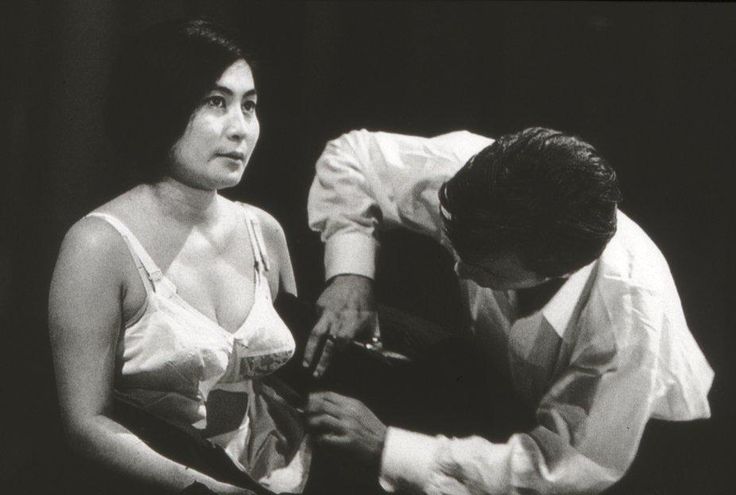
The performances 1-5: the artist sat kneeling on the stage wearing her best suit of clothing, with a pair of scissors placed on the floor in front of her. The members of the audience were invited to approach the stage, one at a time, and cut a bit of her clothes off – which they were allowed to keep. The score for Cut Piece, and other several works, appears in a document from January 1966 called Strip Tease Show.

In the paperback edition of her book, Grapefruit published in 1971, Yoko Ono included a description that concluded with the statement that “the performer, however, does not have to be a woman.”
Cut Piece is one of Ono’s best works, and it was conceived as an event score, so the artist foresaw the work’s realization in a succession of presents. And from the beginning she understood that in each of these presents the work would be transformed from an idea into an experience, each one distinct from the others. Once Yoko Ono described her instructions – or scores – as “seeds” that are activated individually and collectively in the minds and actions of those who receive them. And this germinating idea is manifest in multiple variations, which is very common to happen with her work.
The performance of September 2003
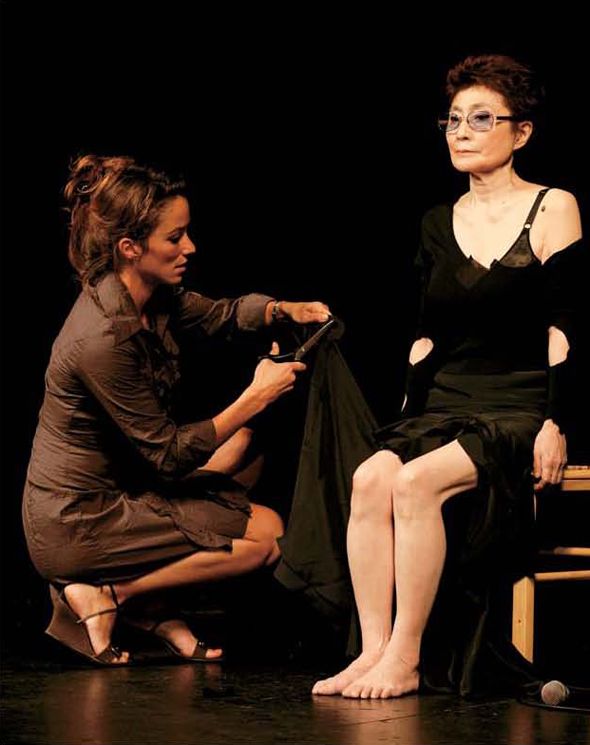
At the age of seventy, Yoko Ono performed Cut Piece in Paris, thirty-nine years after her first performance of it, and she told Reuters News Agency that she did it “against ageism, against racism, against sexism, and against violence”.

Ono’s earlier discussions on Cut Piece’s inspiration and meaning accommodate a number of different readings, nevertheless nowadays it is saw as one-dimensional work, due to the current dominance of feminist approaches by critics and by Yoko Ono herself, who has not only accepted and reinvented in her new performance of 2003.
Since her re-emergence onto the art scene (after have been ignored by the artworld during her years with John Lennon) with a small exhibition of bronzes at the Whitney Museum in 1989, the majority of authors who have considered her work as a visual artist and they have presented her work as “proto-feminist”, typically citing Cut Piece, as a major example from the sixties.
Recently, her work has become increasingly popular and culminating in the recent retrospective exhibition and book, Yes Yoko Ono.
The various interpretations of Cut Piece
Cut Piece is considered as an early example of performance art. Yoko Ono’s vision of this work is very different of that perceived by the critics. For her is a test of her commitment to life as an artist, as a challenge to artistic ego, as a gift, and as a spiritual act. Meanwhile for the critics is a protest against violence and war (specifically Vietnam war), or just a striptease, and most frequently as a feminist work. Although neither her nor the critics framed Cut Piece as a feminist work in the 1960s when she first performed it.
According to Marcia Tanner, Ono’s inspiration for Cut Piece was the legend of the Buddha, who had renounced a life of privilege to wander the world, giving whatever was asked of him. Buddha’s soul achieved supreme enlightenment when he allowed a tiger to devour his body. And for her, Ono see parallels between the Buddha’s selfless giving and the artist’s. She affirms that when addressing serious issues – in the case voyeurism, sexual aggression, gender subordination, violation of a woman’s personal space, violence against women – Ono invariably found means to combine dangerous confrontation with poetry, spirituality, personal vulnerability, and edgy laughter. (Bad girls, 1996)

There is also the idea of giving the audience what it wishes to take, and this is very bound up with hermeneutics, or the reception theory, which is the idea that is the viewer as much as the artist who invents a work of with meaning.
Another interesting reading is according to Julia Bryan-Wilson, that Cut Piece consists of three interlinking gestures: the invitation, the sacrifice, and the souvenir. She said that the invitation happens when Ono invites the audience to participate, to perform with her by approaching the stage and cutting a piece of her clothing. And as Ono has said that she always wore an outfit of her best clothing for the performance, it could be considered as a true offering. This surrender of the artist to the audience’s cutting would signify the sacrifice. And the souvenir lies in the audience being asked to keep the piece of fabric, or as in the performance of 2003 to send it to a loved one, as an act of sharing and continuing remembrance.

Cut Piece wasn’t always a feminist statement. However, since 1990s, it has been considered canonically a feminist work. Even if we know that Yoko Ono had always intended Cut Piece to be performed by men or women – and it was performed by men – thus, a feminist interpretation of the piece seems to presume a female performer.
Based on the nature of the interaction between Ono and her audience during the performances in New York and London, many have interpreted it as a proto-feminist work addressing issues of gender-based violence and objectification and subjugation of women.
In Yoko Ono: Objects and Arias (1991), Barbara Haskell and John G. Hanhardt affirmed that much of Ono’s work is a bold commentary on women, not strident feminist, but her works achieve power because of “their ambiguity; their willingness to forfeit the illusion of politically proper thinking throws responsibility for judgement upon the viewer.”. Within five years, Haskell and Hanhardt’s feminist interpretation had become dominant, cropping up regularly in the popular press as well.
Due to its relative ambiguity, it elicits many readings, some intended by Yoko Ono herself and other inferred by the audience, other artists and historians. Readings of Cut Piece as feminist, pacifist, anti-authoritarian, Buddhist, Christian-and even as a striptease-are all valid.

Curiosities:
- John Lenon noted more than once that Yoko Ono was “the world’s most famous unknown artist”.
- The exhibition Yes Yoko Ono: Japan Society Gallery, New York, from October 18, 2000, through January 14, 2001.
- In 1969, Robert Enright of British women’s magazine Nova, asked her “Did you think if herself as a proto-feminist?”. She said she had any notion of feminism, but she also said what is perhaps one of her best-known statements “Woman is the Nigger of the World”. And in 1972 she and Lennon would issue a controversial pop single of the same title.
- The first documented male performance took place in Central Park on September 9, 1966, as part of the Fourth Annual Avant-Garde Festival organised by charlotte Moorman.
References:
- Concannon, K. Yoko Ono’s “Cut Piece”: From Text to Performance and Back Again. PAJ: A Journal of Performance and Art. Vol. 30, No. 3 (Sep. 2008), pp. 81-93 (13 pages) Published By: The MIT Press
- Bryan-Wilson, J. Remembering Yoko Ono’s “Cut Piece”. Oxford Art Journal Vol. 26, No. 1 (2003), pp. 99-123 (25 pages) Published By: Oxford University Press
- Artsy
- Images: Pinterest

Discover more from Women'n Art
Subscribe to get the latest posts sent to your email.

 Women'n Art
You must be logged in to post a comment.