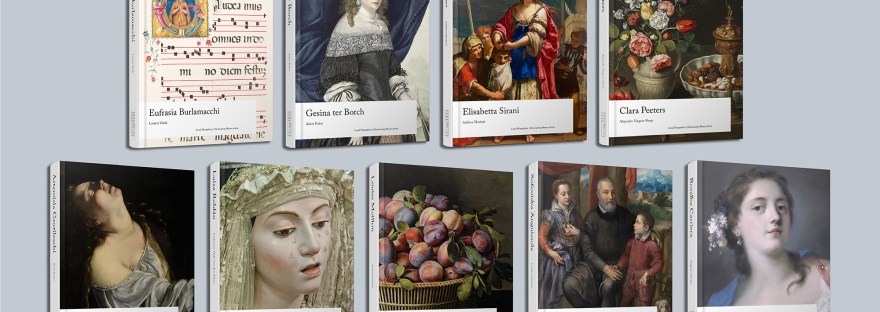
Today’s post is very special, I invited the wonderful Erika Gaffney from Art Herstory, who also works at Lund Humphries Publishers to talk about the beautiful book collection Illuminating Women Artists, and she was kind enough to accept. I hope you all enjoy the reading!
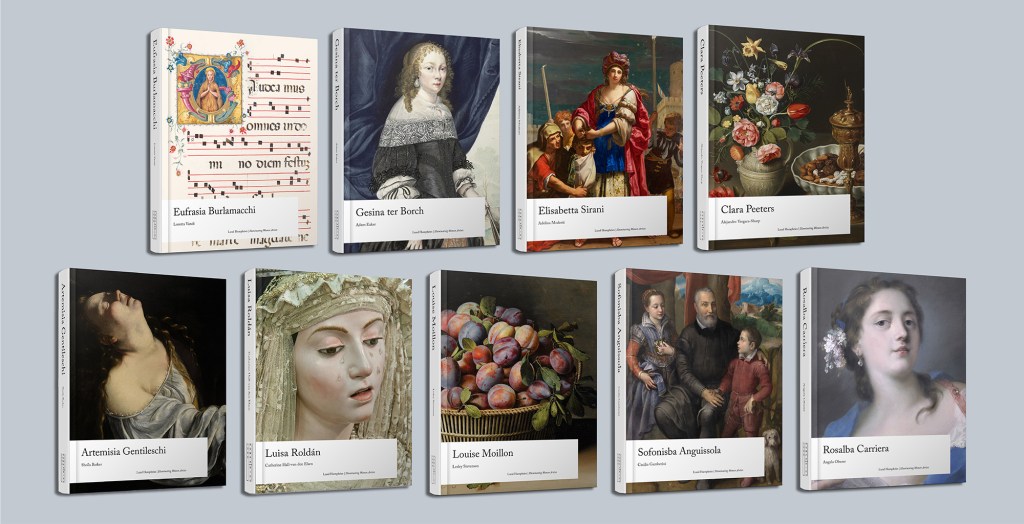
Introducing the Illuminating Women Artists book series
There is vibrant interest today—among scholars, curators, museum-goers, and readers, among others—in the ongoing rediscovery of female makers whose artistic contributions have for too long lain in the shadows of history.
Taking stock of past discoveries and analysis from the past 50 years or so, and incorporating innovative new research, the book series Illuminating Women Artists (IWA) reframes our understanding of the lives, artistic production, and works of art by early European women artists who were active in the early modern period (c. 1400 to 1800). The series originated with London-based art books publisher Lund Humphries, and it is co-published by Getty Publications in North America.
Taken together, IWA books reveal the varied ways in which women of the fifteenth through the eighteenth centuries skillfully and often successfully navigated restricting gender norms to stake out productive lives as artmakers. The volumes offer an unprecedented contextualization of the lives and works of their subjects, to whom in some cases a monograph has not previously been dedicated.

The books in the series are written by rigorously trained art historians; they are peer-reviewed and authoritative. But at the same time, they are accessibly written, so as to be inviting to non-specialists, and priced at a lower level than most scholarly books. And they are lavishly and beautifully illustrated with art by the woman featured and by her contemporaries (male and female), as well as contextual images—maps, examples of objects depicted in paintings, and more.
At the time of writing, there are seven published books in the series. The featured artists are Luisa Roldán, Artemisia Gentileschi, Elisabetta Sirani, Rosalba Carriera, Louise Moillon, Sofonisba Anguissola, and Gesina ter Borch. There are four more books in production: Clara Peeters, Eufrasia Burlamacchi, Josefa de Obidos, and Maria Sibylla Merian. And the subjects of volumes under contract include Anne Vallayer-Coster, Judith Leyster, Rachel Ruysch, Mary Beale, Joanna Koerten, Plautilla Nelli, and Marie-Guillemine Benoist.
There are many more artists the series organizers would like to feature in an IWA volume. The strong current interest in the general topic of historic women artists notwithstanding, there are challenges associated with developing the volumes. One such challenge is identifying authors who have the requisite expertise, including archival skills, and also time to devote to the process of writing the book. (The economics of this kind of publishing do not allow for large royalty advances on which an author might live while writing.) Another hurdle involves the art: even where there’s a substantial body of paintings or other artefacts that can credibly be attributed to a female artist, the works may be in poor condition, or may never have been photographed. And there is the issue of permissions fees. Even though the artworks themselves are usually long out of copyright, sometimes the only way to obtain a high-resolution digital art file from which to make reproductions is to purchase it from the holding institution or a picture library.
Having presented some background about where the series stands now, and the challenges of developing it further, we turn to the series editors for some insider perspective. Andrea Pearson and Marilyn Dunn serve as editors for the Renaissance and Baroque portion of the series. Marilyn Dunn and Melissa Hyde work on the books in the segment of the series that covers the long eighteenth century.

Q&A with IWA series editors Andrea Pearson, Marilyn Dunn and Melissa Hyde
What is the career- or interest-path that led up to your involvement with this series?
Before coming together as editors for the series, we worked separately on women as artists and patrons in our respective subfields. The questions raised in our own research, especially questions of agency, clarified the importance of centering women artists as a scholarly subject.
How would you characterize your role within the series?
We identify artists to include in the series and locate specialists knowledgeable about gender to invite to contribute. Each author submits a proposal for which we offer suggestions about outlines, chapter content, and image selection, noting that flexibility is important in order to accommodate different historical situations. We review sample chapters and the full manuscripts that follow, organize and respond to peer review, and offer constructive advice to help authors develop their ideas to reach the best structure for a book on their subjects. Finally, we offer corrections to the proofs.
What do you see as the challenges and rewards of working on such a series?
In terms of challenges, it is sometimes the case that we cannot find an author to write on a subject we’d like to include. The rewards are many, including making scholarly, accessible books on understudied women artists available to a wider audience. The specialized nature of the volumes is also satisfying for us, since the originality of the books expands our ways of thinking about women artists. While all volumes address issues of gender, each author is permitted to take a flexible approach to the consideration of their subject, as most fitting for the context in which she worked and was able to produce art. We appreciate the opportunity to expand considerations of art production beyond painting to include sculpture, manuscript illumination, printmaking, and even paper cutting. Together, volumes in the series demonstrate that women of the past produced work as both professional and amateur artists.
Do you have any particular hopes for future books in the series? Or, who is the woman artist you most wish to add to the volumes in the pipeline?
A few artists who are not yet in the series come to mind, including Giovanna Garzoni, Orsora Maddalena Caccia, Adélaïde Labille-Guiard, Elisabeth Louise Vigée LeBrun, and Angelica Kauffman. We also hope that books that group subjects or themes can be produced, for this will allow the series to feature women for whom we do not have enough surviving, clearly attributable works of art for a dedicated book.

For further information on IWA series and Erika Gaffney:
- Lund Humphries: Illuminating Women Artists Series
- Art Herstory
- Illuminating Women Artists – Getty Series – Getty Museum Store
All the images were kindly provided by Lund Humphries Publishers.

Discover more from Women'n Art
Subscribe to get the latest posts sent to your email.

 Women'n Art
You must be logged in to post a comment.